
Industry News & Insights
Oracle Transportation Management Spotlight:
2026 Gartner® Magic Quadrant™
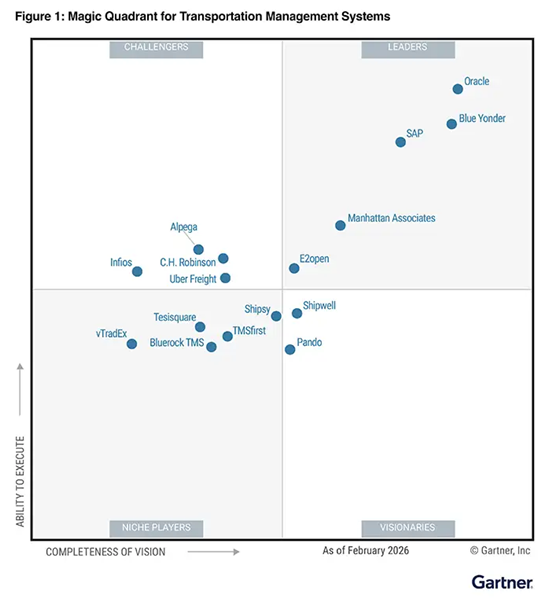
The 2026 Gartner® Magic Quadrant™ for Transportation Management Systems (TMS) reinforces what many supply chain leaders already know, transportation is no longer just execution, it is a strategic lever for cost control, visibility, and resilience.
As complexity increases across global supply chains, organizations are looking for platforms that go beyond basic planning and execution to deliver real-time intelligence, automation, and end-to-end orchestration.
To read the report, tell us more about yourself.
Oracle Recognized as a Leader
Oracle continues its long-standing leadership in the TMS market, building on nearly two decades of recognition in prior reports.
In the most recent evaluation, Oracle has historically been positioned:
This consistent positioning reflects Oracle’s ability to deliver at scale while continuing to invest in innovation across its cloud-based logistics platform.
What’s Driving the Market in 2026
The 2026 report highlights a TMS market that is evolving rapidly, shaped by increasing operational complexity and the need for smarter, faster decision-making.
1. Increased Supply Chain Complexity
Modern supply chains require:
TMS platforms are now expected to manage this complexity seamlessly, not just support it.
2. AI and Automation Are Now Core Capabilities
AI is no longer a future feature, it is embedded directly into leading platforms.
Organizations are leveraging TMS solutions to:
This shift is moving transportation from reactive management to intelligent orchestration.
3. Convergence Across Supply Chain Systems
Transportation is becoming tightly integrated with:
Gartner continues to emphasize the importance of end-to-end supply chain connectivity, where transportation plays a central role in overall performance.
Why Oracle Transportation Management (OTM)
Oracle Transportation Management continues to stand out as a comprehensive platform designed to handle complex, global logistics networks.
Key strengths include:
Modern supply chains require:
OTM enables organizations to optimize transportation operations while improving service levels and reducing costs.
What This Means for Shippers
The 2026 Magic Quadrant makes one thing clear, the bar for TMS has been raised.
To stay competitive, organizations should focus on:
Modern supply chains require:
TMS is no longer just a logistics tool, it is a core system for driving business performance.
How Propero Helps
At Propero, we help organizations maximize the value of their TMS investments, with deep expertise in Oracle OTM and global supply chain transformation.
Whether you are:
Modern supply chains require:
We help you move faster, reduce risk, and unlock measurable results.
Leave A Comment